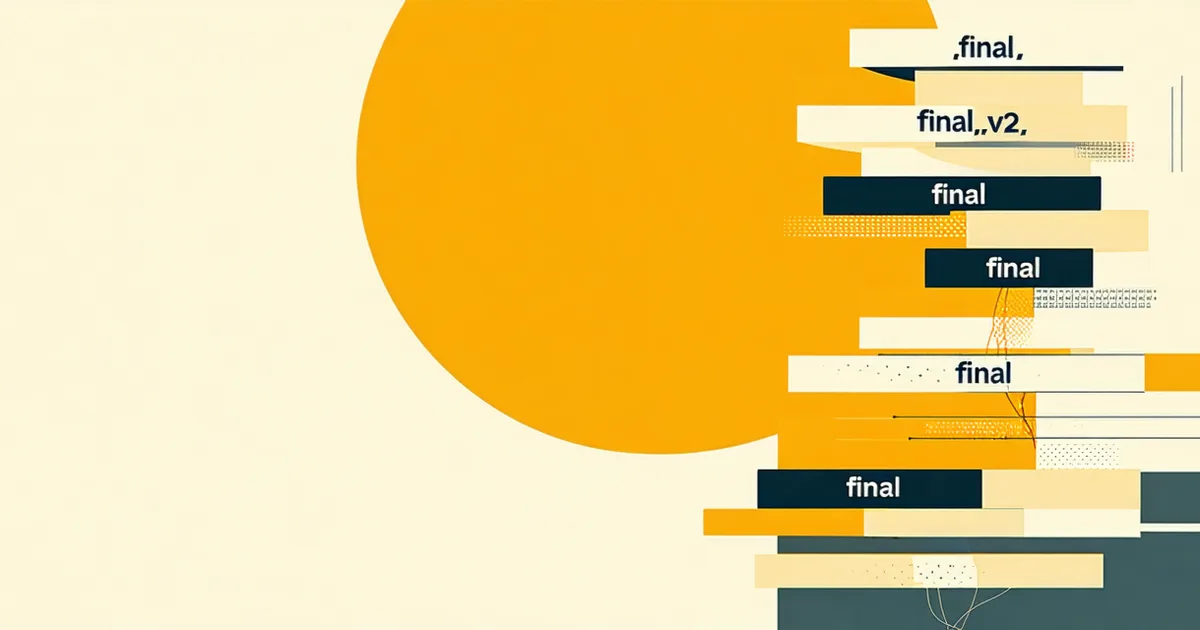
There's a file on someone's desktop right now named campaign_hero_FINAL_USE_THIS_v4.pdf. The v4 part is the tell. Not because saving four iterations is wrong — it isn't — but because the filename is doing the job that a version system should be doing. The file name has become the version record.
This is what version chaos looks like at the file level: it's not disorganization, it's an overloaded naming convention doing structural work it was never meant to carry. And once you understand that, the cost calculation becomes clearer than most people expect.
Where the hours actually go
The most visible cost of file-name versioning is the time spent finding the right file. A brand designer on a mid-size in-house team — say a four-person group managing six to eight concurrent campaigns — can spend 20 to 40 minutes per week just reconstructing file provenance. Which version did the VP approve? Which one has the color fix from last Tuesday? Was the copy update already in v3, or did it come in after?
Multiply that across the team and you're looking at roughly two to three hours of collective time per week that produces no design output. Over a year, that's north of 100 person-hours on a four-person team — not on creative problem-solving, but on file archaeology.
The less visible cost is decision erosion. When reviewers aren't sure which version they're looking at, they either hedge their feedback ("assuming this is the current one...") or they comment on the wrong state entirely. The designer then has to triangulate: is this feedback about what I showed in the meeting, what I emailed yesterday, or what's in the shared folder now? That context-reconstruction overhead is real work that doesn't show up in any time tracking.
Why the file name became a version system
Version chaos doesn't start from laziness. It starts from a legitimate need — tracking state — combined with the absence of infrastructure designed to meet that need. A file in Dropbox or Google Drive doesn't have a "this is the approved state" marker. It doesn't have a "reviewers have seen this" flag. The only writable property you control is the name.
So designers do what any reasonable person does: they encode state in the one place they can. _FINAL means approved. _v2 means a new iteration. _USE_THIS means the other files in the folder are traps.
The problem is that naming conventions drift under pressure. When a campaign sprint is accelerating and three stakeholders have sent conflicting feedback by 4pm, nobody is updating the canonical naming convention doc. The files proliferate, the names get more emphatic, and you end up with _FINAL_v3_ACTUAL_FINAL — a filename that is at once funny and genuinely stressful.
The version-per-phase confusion
A subtler and more damaging failure mode is versioning a file when you should be versioning a phase. Consider a brand campaign that goes through concept exploration, stakeholder alignment, copy approval, and production handoff. These are four meaningfully different states of the same work. But if every iteration within each phase increments the same version counter, you end up with summer-launch-brand_v17.psd where v1 through v5 are concept explorations, v6 through v10 are alignment drafts, and v11 through v17 are production iterations — but nothing in the filename tells you that.
A designer inheriting that file mid-project has no way to know that the approved concept locked at v5, that v9 was rejected, or that v14 introduced a color correction that everyone forgot about by v17. The version number is a counter, not a record.
This is where versioned canvases with named snapshots change the dynamic. When a save point is called Concept A — stakeholder approved rather than v5, the next designer who opens it knows immediately which state it represents. The name is part of the record, not a substitute for it.
The hidden tax on creative momentum
Consider a concrete scenario: a brand team at a growing consumer goods company is working on a packaging refresh in early 2024. The project runs across eight weeks and involves a brand designer, a creative director, a marketing manager, and an external packaging vendor. Files are exchanged via email attachments and a shared Dropbox folder.
By week four, there are three competing "final" files in the folder — each created at a different point by a different person who believed theirs was the latest. The packaging vendor prints samples off the wrong one. The brand designer spends a full day identifying the discrepancy, coordinating the correction, and resending the correct assets. The creative director's Friday afternoon is consumed by a post-mortem that could have been a five-minute version log review.
That one incident cost roughly 12 to 15 hours across the team. Not because anyone was careless, but because the version infrastructure assumed that file names were sufficient version control. They weren't.
What "fixing" version chaos doesn't mean
We're not saying every brand team needs the equivalent of Git branches and pull requests. That framing tends to produce tools nobody uses, because the cognitive overhead of branch management is genuinely high for a team whose primary job is visual problem-solving, not code management.
What a brand team actually needs is simpler: named snapshots tied to meaningful milestones, a visible audit trail that answers "what did we show and when," and a single canonical state that everyone references rather than a proliferation of files that all compete to be the real one.
The mechanism can be lightweight. What matters is that it's integrated into the design environment rather than bolted on top — so creating a snapshot costs a few seconds, not a workflow interruption. When the cost of versioning approaches zero, designers actually do it consistently. When it requires switching tools or maintaining a separate spreadsheet, it gets skipped under deadline pressure, which is exactly when you need it most.
When "good enough" workflows start failing
File-name versioning works reasonably well when a project has a single designer and a single reviewer, the timeline is short, and the stakes are modest. The failure surface expands predictably with each additional variable: more reviewers, longer timelines, higher stakes, more iterations, more channels for feedback to arrive through.
In-house brand teams at growing companies tend to sit exactly at the inflection point where file-name versioning has been "good enough" historically but is now quietly generating debt. The campaigns are bigger, the stakeholder list has grown, the pace hasn't slowed. The version chaos is often visible in the daily friction — the "which file is this?" Slack messages, the "I thought we approved that already" review calls — but rarely traced back to the structural cause.
The structural cause is the absence of a version record that's designed to hold that information. Not a more elaborate naming convention. A version record.